
Hindutva and the Colonial Morality It Calls Tradition
Hindutva’s “culture defense” often mirrors Victorian sexual repression more than India’s historically plural, contradictory traditions. What gets preserved through moral panic is less heritage than a colonial framework of shame repackaged as pride.
Posted by

Related reading
The Rentier State Behind Authoritarianism
Authoritarianism is often blamed on religion when the deeper cause is political economy. States financed by oil, foreign patrons, or illicit markets can survive without taxation—and therefore without accountability to their citizens.
Why Threats Against Judges Cluster Around Power Disputes
Judges aren’t threatened in proportion to a ruling’s moral horror, but to the losing side’s organized, identity-bound capacity to coerce. The antidote is conduct-based enforcement and post-harm incentive forensics—not category-based repression.
Stop Selling Reservation as Welfare: It’s Representation
The reservation debate stays stuck because it’s framed as compensation, poverty relief, or a temporary ladder. A representation-and-reach framing treats it instead as institutional design: building a state that serves every stakeholder it governs.
Hindutva Isn’t Defending Indian Culture. It’s Defending Victorian Morality in Saffron.

There’s a lie sitting at the center of modern Hindutva, and it’s repeated so often that people treat it like a law of nature: that Hindutva is “protecting Indian culture.”
It isn’t. What it’s actually protecting—loudly, punitively, and with constant moral panic—is a Victorian moral framework that entered India through colonial rule, got internalized by elites and institutions, and then got repackaged as “tradition” by political movements that needed a weapon.
This isn’t cultural preservation. It’s a colonial hangover sold as pride.
A civilization that carved sex into stone didn’t need “decency lessons”
Start with the most obvious contradiction: India is not a civilization that historically behaved like a prudish, trembling Victorian drawing room.
Pre-colonial Indian culture was many things—hierarchical, unequal, often cruel—but it wasn’t defined by the specific Victorian terror of the body and the obsessive need to turn desire into shame.
You can see that in plain sight:
- Temple art that includes explicit sexual imagery
- Textual traditions that discuss sex openly (not as “sin,” but as part of life)
- Myth and ritual traditions that hold more fluid ideas of gender and form
- Devotional and poetic traditions that don’t treat desire as inherently dirty
None of this means pre-colonial India was some utopia of sexual freedom. It wasn’t. But it also wasn’t built on the Victorian premise that sex is a contaminant and visibility itself is corruption.
Victorian culture treated sex as something that must be hidden, suppressed, and punished—an ever-present threat to “civilization.” That flavor of fear is not an ancient Indian inheritance. It’s an imported mood.
Colonialism didn’t just rule India. It disciplined it.
British rule didn’t merely conquer territory. It colonized the moral imagination.
Victorian England arrived with a full moral ideology: sexual repression, public respectability, female “purity,” surveillance disguised as virtue. It looked at Indian social life—its temples, poetry, customs—and labeled it “degenerate,” “immoral,” and in need of correction.
And then it did what empires do: it enforced its worldview through law and institutions.
Some of the big moves are well known:
- Laws criminalizing homosexuality (such as Section 377)
- Legal and administrative obsession with “obscenity”
- A broader project of regulating bodies, sexuality, and public behavior
This is the key point: when you turn moral judgments into legal frameworks, you don’t just change behavior—you re-train a society to experience itself through shame. You teach people to see their own traditions as something to be policed.
The British didn’t merely claim India lacked “discipline.” They installed discipline as governance and called it civilization.
Hindutva inherited colonial shame—and mistook it for “Indian values”
Here’s where the tragedy becomes farce.
Instead of rejecting Victorian moral frameworks as colonial impositions, large parts of postcolonial society absorbed them. Over time, what was originally imposed as foreign “respectability” got rebranded as native “culture.” Then Hindutva came along and weaponized that confusion: it took the inherited Victorian moral code, wrapped it in nationalist symbolism, and marketed it as dharma under attack.
So what does “defending Indian culture” often look like in practice?
It looks like:
- Panic about dating
- Hostility to public affection
- Moral hysteria around women’s autonomy
- Policing of what women wear, where they go, and who they meet
- Framing LGBTQ existence as a civilizational threat
- Treating “choice” as contamination and “control” as protection
That entire emotional register—the trembling fear that personal freedom will dissolve civilization—is Victorian. It isn’t Vedic. It isn’t timeless. It’s a historical artifact, preserved because it’s useful.

Image credit: Wikimedia Commons

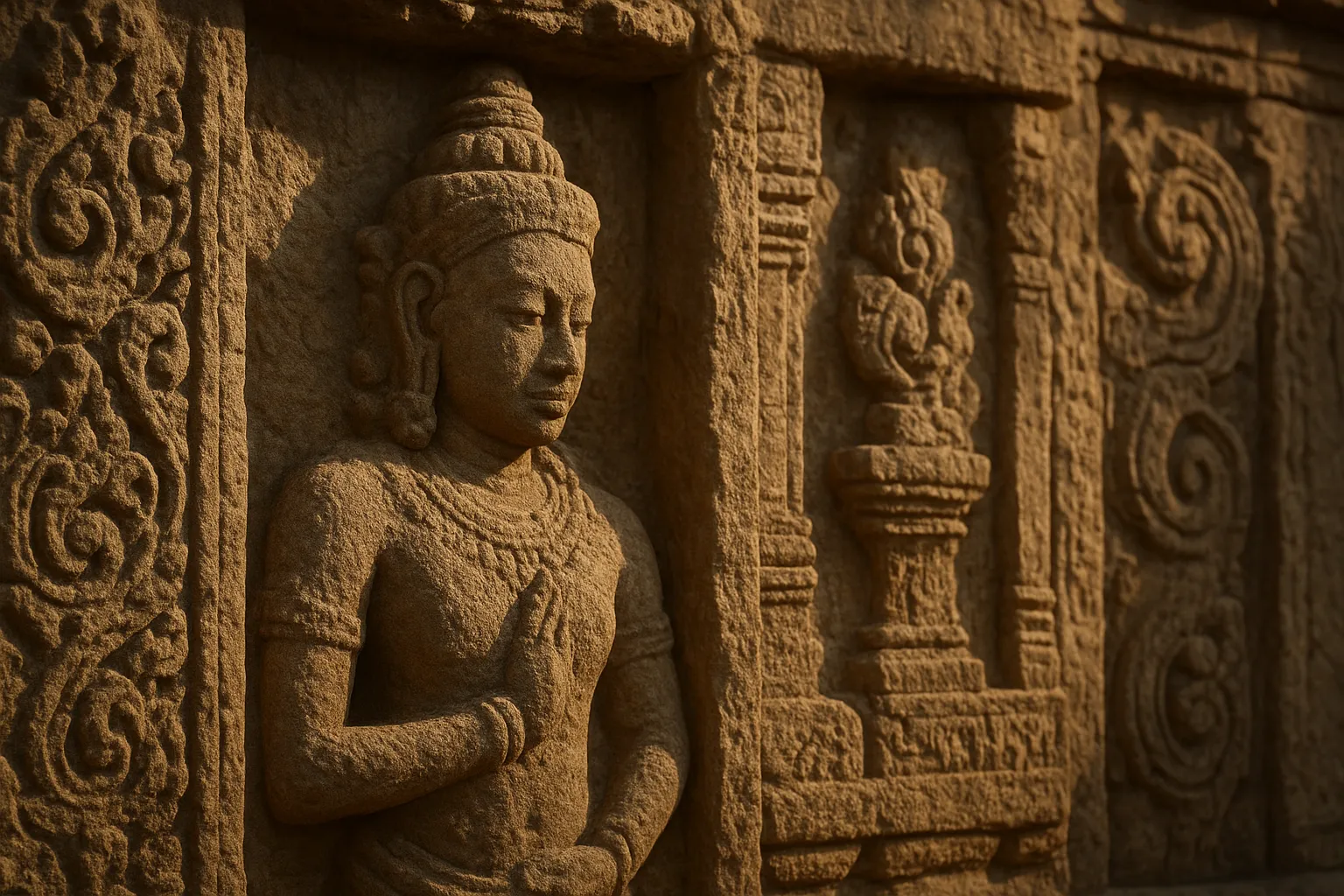
And Hindutva doesn’t just preserve it. It sanctifies it.
The temple-wall test: why the mismatch is so glaring
Ask one question and watch the story collapse: why does a country with temples full of erotic art also produce street-level outrage over a kiss?
That mismatch isn’t accidental.
Hindutva Isn’t Defending Indian Culture. It’s Defending Victorian Morality in Saffron.
There’s a lie sitting at the center of modern Hindutva, and it’s repeated so often that people treat it like a law of nature: that Hindutva is “protecting Indian culture.”
It isn’t. What it’s actually protecting—loudly, punitively, and with constant moral panic—is a Victorian moral framework that entered India through colonial rule, got internalized by elites and institutions, and then got repackaged as “tradition” by political movements that needed a weapon.
This isn’t cultural preservation. It’s a colonial hangover sold as pride.
A civilization that carved sex into stone didn’t need “decency lessons”
Start with the most obvious contradiction: India is not a civilization that historically behaved like a prudish, trembling Victorian drawing room.
Pre-colonial Indian culture was many things—hierarchical, unequal, often cruel—but it wasn’t defined by the specific Victorian terror of the body and the obsessive need to turn desire into shame.
You can see that in plain sight:
- Temple art that includes explicit sexual imagery
- Textual traditions that discuss sex openly (not as “sin,” but as part of life)
- Myth and ritual traditions that hold more fluid ideas of gender and form
- Devotional and poetic traditions that don’t treat desire as inherently dirty
None of this means pre-colonial India was some utopia of sexual freedom. It wasn’t. But it also wasn’t built on the Victorian premise that sex is a contaminant and visibility itself is corruption.
Victorian culture treated sex as something that must be hidden, suppressed, and punished—an ever-present threat to “civilization.” That flavor of fear is not an ancient Indian inheritance. It’s an imported mood.
Colonialism didn’t just rule India. It disciplined it.
British rule didn’t merely conquer territory. It colonized the moral imagination.
Victorian England arrived with a full moral ideology: sexual repression, public respectability, female “purity,” surveillance disguised as virtue. It looked at Indian social life—its temples, poetry, customs—and labeled it “degenerate,” “immoral,” and in need of correction.
And then it did what empires do: it enforced its worldview through law and institutions.
Some of the big moves are well known:
- Laws criminalizing homosexuality (such as Section 377)
- Legal and administrative obsession with “obscenity”
- A broader project of regulating bodies, sexuality, and public behavior
This is the key point: when you turn moral judgments into legal frameworks, you don’t just change behavior—you re-train a society to experience itself through shame. You teach people to see their own traditions as something to be policed.
The British didn’t merely claim India lacked “discipline.” They installed discipline as governance and called it civilization.
Hindutva inherited colonial shame—and mistook it for “Indian values”
Here’s where the tragedy becomes farce.
Instead of rejecting Victorian moral frameworks as colonial impositions, large parts of postcolonial society absorbed them. Over time, what was originally imposed as foreign “respectability” got rebranded as native “culture.” Then Hindutva came along and weaponized that confusion: it took the inherited Victorian moral code, wrapped it in nationalist symbolism, and marketed it as dharma under attack.
So what does “defending Indian culture” often look like in practice?
It looks like:
- Panic about dating
- Hostility to public affection
- Moral hysteria around women’s autonomy
- Policing of what women wear, where they go, and who they meet
- Framing LGBTQ existence as a civilizational threat
- Treating “choice” as contamination and “control” as protection
That entire emotional register—the trembling fear that personal freedom will dissolve civilization—is Victorian. It isn’t Vedic. It isn’t timeless. It’s a historical artifact, preserved because it’s useful.
And Hindutva doesn’t just preserve it. It sanctifies it.
The temple-wall test: why the mismatch is so glaring
Ask one question and watch the story collapse: why does a country with temples full of erotic art also produce street-level outrage over a kiss?
That mismatch isn’t accidental. It’s the result of selective memory.
Hindutva doesn’t defend “Indian culture” as it existed in all its complexity. It defends a curated version of culture—one that privileges authority, hierarchy, and control, while discarding ambiguity, play, and pluralism.
Because ambiguity is the enemy of moral policing.
A culture comfortable with contradiction is hard to govern through fear. But a culture reduced to rigid binaries—pure/impure, good/bad, us/them—is incredibly easy to mobilize. Victorian morality is basically a binary machine. Once you install it, you can manufacture outrage on demand.
“Protecting women” is a Victorian trope dressed up as tradition
One of the clearest signs that this isn’t really about “ancient culture” is how closely the rhetoric resembles Victorian paternalism.
Victorian ideology loved the idea that women are both fragile and dangerous—morally delicate, sexually catastrophic, and therefore in need of supervision “for their own good.” It’s a worldview where control gets renamed as care.
Modern moral policing often runs on the same script:
- Women must be protected from desire
- Women must be protected from visibility
- Women must be protected from choice
The subtext is always the same: if women are free, civilization collapses.
That sentence could be lifted from a 19th-century sermon without changing a word.
It doesn’t become “Indian” just because it’s shouted in the language of nationalism.
Moral panic isn’t culture. It’s power.
There’s a reason this Victorian inheritance survives: it’s politically efficient.
Sexual anxiety is one of the easiest emotions to manufacture and weaponize. It creates instant enemies and justifies instant punishment. It lets power present itself as virtue.
Moral panic does a lot of work for free:
- It distracts from economic and governance failure
- It offers simple villains when reality is complex
- It produces a permanent state of emergency
- It turns surveillance into “civilizational defense”
- It makes cruelty feel like duty
That’s why you see obsession with women’s bodies and sexuality show up again and again: because control over intimacy is control over society. It’s not the only tool of power, but it’s one of the oldest and most reliable.
And Victorian morality provides the perfect language for it: cleanliness, decency, tradition, purity. Words that sound noble until you notice what they’re being used to justify.
The blunt conclusion Hindutva refuses to face
Hindutva wants the aesthetic of anti-colonial pride while running colonial moral software.
It wants to posture as a defender of “Indian civilization” while enforcing the very prudishness that colonial rulers used to frame Indians as undisciplined and in need of rule.
That contradiction doesn’t get resolved by shouting louder. It gets resolved by admitting what’s actually happening.
You can defend Indian culture in its messy, plural, contradictory reality. Or you can defend Victorian sexual anxiety and call it tradition. You can’t honestly do both.
Conclusion
If a movement’s “culture defense” mostly looks like surveillance, shame, and hysteria about desire, it isn’t defending culture—it’s defending control. The most bitter irony is that this control doesn’t even come from deep indigenous roots; it comes from a colonial moral regime that trained people to fear themselves. Wrap it in saffron, call it pride, and it’s still Victorian at the core.