
Magnetism Isn’t Space Bending
Gravity is modeled as curved spacetime; magnetism isn’t. Magnetism is best understood as electricity viewed through motion and special relativity (plus quantum spin alignment for permanent magnets).
Posted by

If Gravity Is Space Bending, What Is Magnetism?
Image credit: Wikimedia Commons
It’s tempting to lump gravity and magnetism together because they both “pull” and both show up in those iconic textbook diagrams—bowling balls on rubber sheets, iron filings around bar magnets. But the similarity is mostly aesthetic.
Gravity, in Einstein’s picture, is geometric. Magnetism isn’t.
Gravity: the geometric one
General relativity’s core move is to stop treating gravity as a force in the usual push/pull sense and instead treat it as curved spacetime:
- Mass/energy curves spacetime.
- Objects move along the straightest possible paths in that curved geometry.
- That curved geometry is what we experience as “gravity.”
So gravity isn’t just in space; it’s tied to what space and time are doing.
Magnetism: not curved spacetime
Magnetism doesn’t require spacetime to be bent. It comes from something more sneaky:
- electric charge
- motion
- relativity (special relativity, not the curved-spacetime kind)
The clean way to say it is:
Magnetism is what electric fields look like when charges are moving relative to you.
Electricity and magnetism are not two different forces stitched together; they’re two faces of the same thing (electromagnetism). Whether you call what you see “electric” or “magnetic” depends on your state of motion.
The key idea: “magnetic” is “electric, but from a moving frame”
Start with something basic:
- Charges produce electric fields.
- When charges move (a current), the story changes depending on who is watching.
Special relativity says lengths contract along the direction of motion. That matters because “how much charge per length” (charge density) is not the same for every observer. Change the charge density, and you change the electric field you infer.
In many situations, when you do that properly, what pops out is an extra sideways force we summarize as a magnetic field.
So magnetism isn’t “space bending.” It’s a relativistic consequence of electricity.
A concrete intuition: two current-carrying wires
The classic mental image is two parallel wires carrying current:
- Each wire contains moving electrons (that’s the current).
- The wires can attract or repel depending on current direction.
- That interaction is what we call magnetism.
Here’s the twist: you can analyze that attraction as an electric effect once you account for relativity.
From the viewpoint of an electron in one wire, charges in the other wire don’t have the same motion they had in the lab frame. With length contraction, the apparent charge densities shift. That creates an electric field imbalance, which produces a force. In the lab frame we package the same physics as “magnetic force.”
Nothing about “space being bent like gravity” is required to make that work.
“But permanent magnets work even when nothing is moving”
This is where people feel like the “moving charges” explanation collapses. A fridge magnet just sits there and still has a magnetic field.
The missing piece is that “moving charge” isn’t only about charges marching down a wire in a neat current. In permanent magnets:
- electrons have spin (a quantum property)
- spin comes with a tiny magnetic moment
- in most materials those moments point in random directions and cancel out
- in ferromagnets (like iron), many of them align, producing a large-scale magnetic field
So you can roughly split it like this:
- Classical magnetism: moving charges (currents)
- Permanent magnetism: quantum alignment of electron magnetic moments (spin-driven)
Either way, it’s still electromagnetism—not spacetime curvature.
Why gravity feels “fundamentally different”
Part of what confuses this topic is that electromagnetism and gravity are both long-range and field-like, so the diagrams invite comparison. But there’s a sharp conceptual difference:
- With electromagnetism, what you label “electric” vs “magnetic” depends on motion. Change frames and you can reshuffle the two.
- With gravity (in general relativity), you’re dealing with the geometry itself. It’s not just a field living in spacetime; it’s tied to spacetime’s shape.
A blunt way to summarize the vibe:
- Magnetism can disappear or change character depending on your reference frame.
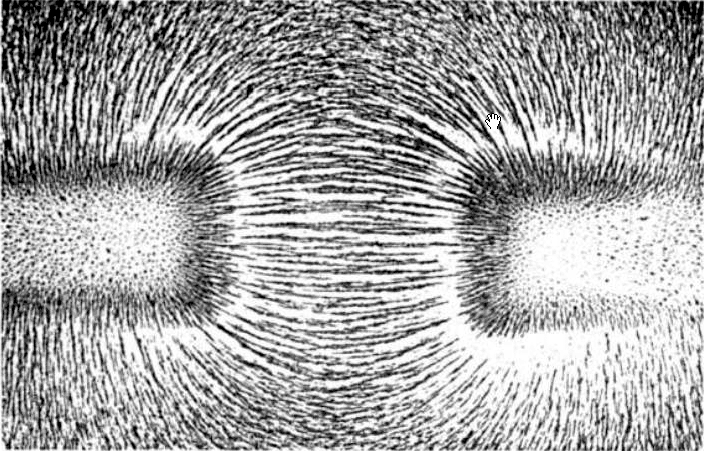
Image credit: Wikimedia Commons


Image credit: Wikimedia Commons

- Gravity isn’t a frame-dependent bookkeeping trick; it’s built into the geometry.
The takeaway
Gravity is modeled as spacetime curvature caused by mass/energy.
Magnetism is what happens when electric fields are viewed through motion and special relativity (and, for permanent magnets, quantum spin alignment).