
Most Conspiracies Are Just Incentives Lining Up
Many events that look like coordinated plots are better explained by a stack of aligned incentives across platforms, media, creators, and audiences. Real conspiracies exist—but they leave a different trail: secrecy, directives, and documentation.
Posted by

Related reading
MCU Thor and Norse Myth: Shared Names, Different Logic
Marvel’s Thor borrows real Norse names and symbols, but swaps the myth’s tone, family ties, and fatalistic cosmology for superhero storytelling. That same “remix” approach is rarer with Indian mythology because it’s a living, devotional tradition with higher cultural and political stakes.
The Odyssey Casting Debate Is a Trust Crisis
The loudest reactions to The Odyssey’s casting aren’t really about diversity or mythic reinterpretation—they’re about audience trust. When studios deny obvious signaling and moralize disagreement, even defensible artistic choices start to read like propaganda.
Abundance Doesn’t Calm Factions It Supercharges Them
Fallout’s pre-war world suggests prosperity doesn’t automatically reduce extremism—it expands what powerful, insulated factions are capable of attempting. When high capability meets low trust and concentrated power, “total solutions” start to look rational.
The Most Misunderstood “Conspiracy”: A Stack of Aligning Incentives
 A lot of what people call “conspiracies” aren’t conspiracies at all. They’re something more boring, more common, and—annoyingly—more powerful: a stack of aligning incentives.
That phrase sounds like corporate jargon until you start noticing how often it explains the real world better than the classic “smoke-filled room” story. Especially online, where outcomes regularly look coordinated even when nobody is coordinating anything.
This isn’t a plea to be naive. Real conspiracies exist. Some are documented, deliberate, and brutal. But if you treat every viral outrage cycle or media pile-on as an orchestrated plot, you end up hallucinating masterminds where there are mostly just systems doing what they’re designed to do: reward behavior that spreads.
Why outrage waves feel “made up” (even when many people are sincere)
Take the kind of backlash that hits high-visibility public figures—founders, big creators, CEOs who talk like humans instead of PR statements.
You’ll see a familiar pattern:
- A comment, clip, or decision gets pulled out of context (or interpreted in the least charitable way).
- A few accounts amplify it with moral certainty.
- Media and creators sense blood in the water.
- The timeline floods with takes that are strangely similar in tone and framing.
- A week later, everyone moves on with no resolution and no clear “win.”
It feels coordinated because the volume and timing look unnatural. But often the underlying mechanism is simpler: lots of independent actors chasing rewards in the same direction at the same time.
The Deepinder Goyal / Ranveer Allahbadia dynamic (as a pattern, not a case file)
When outrage hits someone like Deepinder Goyal, it often clusters around things that are easy to moralize: labor, pricing, culture-war adjacency, “elite vs common man” framing. When it hits someone like Ranveer Allahbadia, it’s usually about platforming the “wrong” guest, saying something clumsy, or stepping outside the narrow lane certain online groups want him to stay in.
Different triggers. Similar shape.
In both cases, the intensity of the reaction can feel wildly disproportionate to the original “offense.” That gap—between the stimulus and the response—is where people start reaching for conspiracy explanations.
But you don’t need a central planner to get a pile-on. You just need incentives that point in the same direction.
Conspiracy vs. incentive stack: what’s the difference?
A real conspiracy typically requires:
- central planning
- secrecy
- discipline
- enforcement
- long-term coordination
That’s hard. Not impossible, but hard.
Aligned incentives, on the other hand, require:
- self-interest
- short feedback loops
- public signals
- imitation
- low friction participation
That’s easy. And it scales.
When the incentives are aligned, people don’t need to be told what to do. They can “freely choose” the same action because the environment rewards that action. You get the same outcome as coordination—without coordination.
This is exactly why so many modern “conspiracies” have the same vibe: they flare up, peak fast, and collapse with no endgame. There’s no final act because there was never a script.
The outrage machine: nobody has to run it
Online outrage is a growth system disguised as morality.
No one needs to issue orders like “attack X.” Instead, each participant plays their role for their own reasons:
- Platforms reward anger because anger drives engagement.
- Media rewards speed because speed beats accuracy in the attention economy.
- Creators reward virality because virality is distribution.
- Political ecosystem players reward signaling because signaling mobilizes tribes.
- Regular users reward certainty because certainty feels good (and ambiguity feels like weakness).
Everyone moves independently. The result looks coordinated.
And once the first wave hits, it becomes self-sustaining. People aren’t just reacting to the original trigger anymore—they’re reacting to the fact that everyone is reacting. At that point, outrage is less about the event and more about the social opportunity: dunking, signaling, joining the winning side, avoiding being targeted next.
Who benefits from amplifying outrage?
Not “who started it”—that’s often unknowable and sometimes irrelevant. A better question is: who benefits from it continuing, and who pays no cost?
Some common beneficiaries:
- Political ecosystem players (not always parties directly): high-visibility targets are useful symbols, especially when the topic overlaps with labor, nationalism, religion, or class resentment.
- Media and creator economy: rage content is cheap, fast, and high-performing. “X slammed for Y” is basically a content template.
- Competitors and adjacent interests: not necessarily direct attacks, but there’s often a quiet incentive to let the fire burn.
- The moral grandstanding crowd: unpaid, uncoordinated, but extremely useful fuel—high need to signal virtue, low tolerance for ambiguity.
Calling it “fake outrage” misses something important. Most of the people participating are sincere. The emotions are real. What’s artificial is the amplification: what gets boosted, what gets framed, and who gets selected as the week’s villain.
Why people prefer conspiracy explanations anyway
Conspiracy stories have a clean appeal:
- a villain
- a narrative arc
- the comfort of intentionality (“someone is in charge”)
Aligned incentives offer something less emotionally satisfying:
- banality
- randomness
- messy systems
- the unsettling idea that nobody is driving
It’s scarier to accept that mass behavior can be steered without a steering wheel. That systems can produce outcomes that feel designed even when they’re just optimized.
Here’s a rough rule that filters out a lot of bad analysis:
- If it requires competence, it’s less likely.
- If it requires incentives, it’s more likely.
That doesn’t mean “never a conspiracy.” It means don’t default to one when the incentives already explain the behavior.
But yes: some conspiracies are real
The mistake people make is swinging between extremes:
- “Everything is a conspiracy.”
- “Nothing is a conspiracy, it’s all emergent behavior.”
Both are lazy. The actual skill is distinguishing between incentive convergence and deliberate coordination.
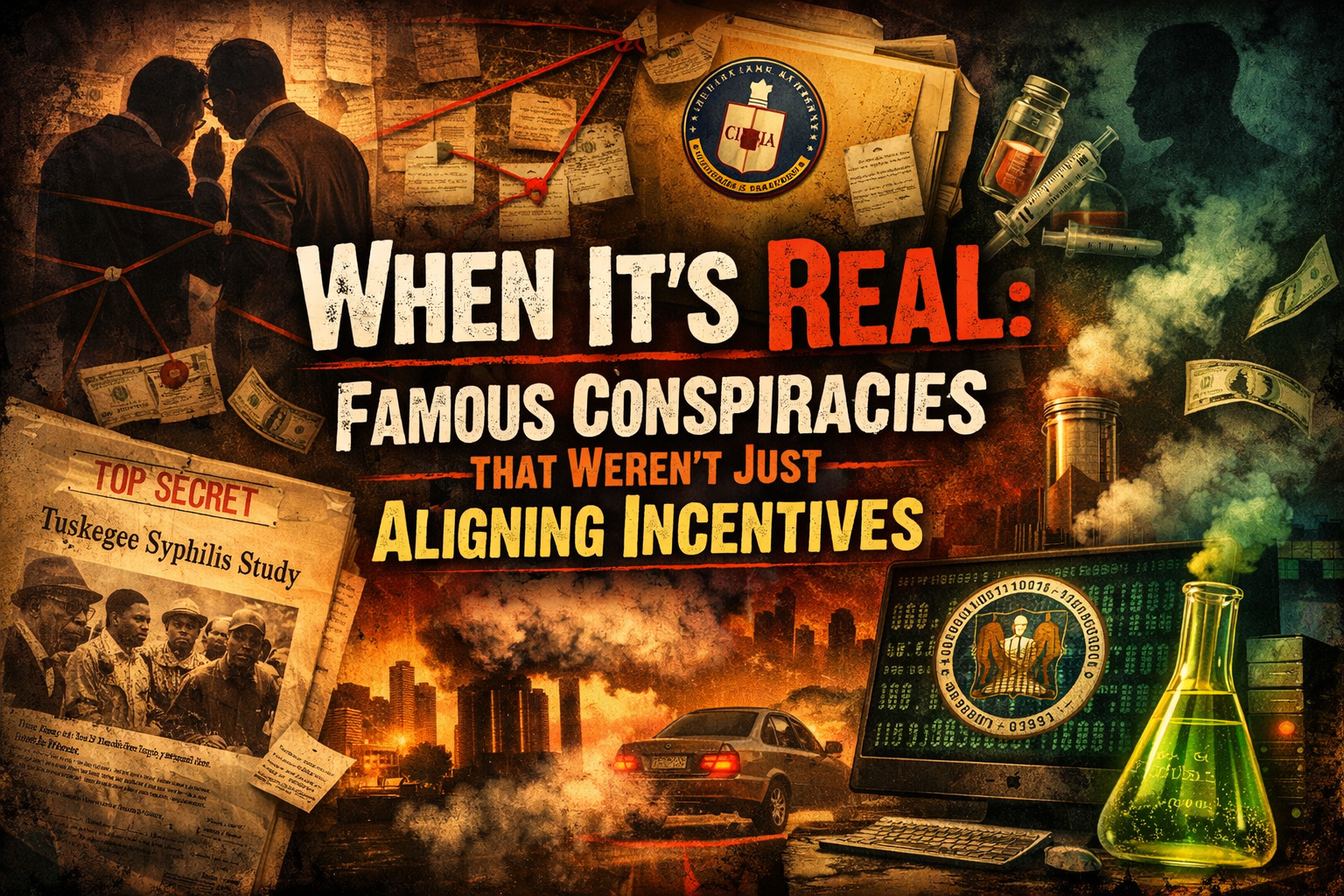
Examples of real conspiracies—where you have documented intent, secrecy, and execution—include:
- MKUltra: a CIA program involving secret experiments (including LSD and psychological methods), characterized by classified funding, concealment, and later admissions.
- Tuskegee Syphilis Study: deliberate withholding of treatment from Black men to observe disease progression, maintained through deception even after penicillin existed.
- COINTELPRO: FBI operations to infiltrate and disrupt political and civil rights groups, involving coordinated disinformation and directives to “neutralize” targets.
- Big Tobacco cover-up: companies knew smoking caused cancer and addiction and coordinated to suppress research and shape public doubt.
- NSA mass surveillance (pre-Snowden): formal surveillance programs denied publicly for years, involving compartmentalization and deception toward oversight.
- Volkswagen emissions cheating: intentional technical deception to pass tests while polluting under normal driving conditions.
The common thread isn’t “powerful people did something bad.” The thread is documented secrecy and coordination—the thing that incentives alone can’t explain.
A practical litmus test: four questions
When you hear a claim that something is an “actual conspiracy,” don’t start with vibes. Start with structure. Ask:
- Were people explicitly instructed to lie or hide?
- Is there documentary evidence (memos, code, orders)?
- Did whistleblowers face retaliation?
- Did the behavior require secrecy to work?
If the answer is “yes” to most of these, you’re closer to real conspiracy territory. If not, you’re probably looking at incentive convergence, institutional inertia, or opportunistic exploitation.
Conclusion
Most of the time, the world doesn’t need villains with master plans; it just needs environments that reward the same behavior from thousands of independent actors. That’s why outrage can look manufactured even when it’s driven by sincere people chasing attention, safety, or status. Real conspiracies do exist, but they leave a different kind of trail—one made of instructions, secrecy, and enforcement. The trick is learning which pattern you’re looking at before you start telling yourself a story.