
Soul Sante and the Unromantic Truth of Founding
A market stall day became a lesson in founder reality: when plans fail, you do the work; when you sell face-to-face, you get clean truth; and when you build, you lean on a village. Humility and connectedness aren’t soft values—they’re operational foundations.
Posted by

Related reading
Small Businesses Must Earn the Sale
Buying local should not require guilt or extra administrative work. Independent businesses thrive when distinctive products are paired with convenience, reliability and genuine customer value.
A vegan market forced Good Gut Hut to confront what matters on first contact: taste, clarity, and a simple pitch. The weekend didn’t make the brand bigger—it made it real.
What a Market Stall Taught Me About Masculinity
I went to Soul Sante expecting to sell pickles. Instead, I found a version of masculinity that had nothing to do with dominance or income. Standing in front of the stall, absorbing rejection and generating attention, I discovered that clean usefulness feels better than status ever did.
What Soul Sante Taught Me About Being a Founder (It Wasn’t Business Tips)
My first Soul Sante wasn’t really about Soul Sante.
It wasn’t even about my products.
It was about what it actually takes to be a founder when the romance fades and the work shows up in its most unglamorous form. If I had to compress the whole day into two words, it would be humility and connectedness.
Not the “humility” you quote on a poster. The kind that makes you roll up your sleeves because nobody else is coming. The kind that forces you to accept help without turning it into a guilt trip. The kind that makes you stand in one place for hours and let strangers decide—immediately—whether you’re any good.
And it started in the most literal way possible.
The Day I Became the Vegetable Chopper
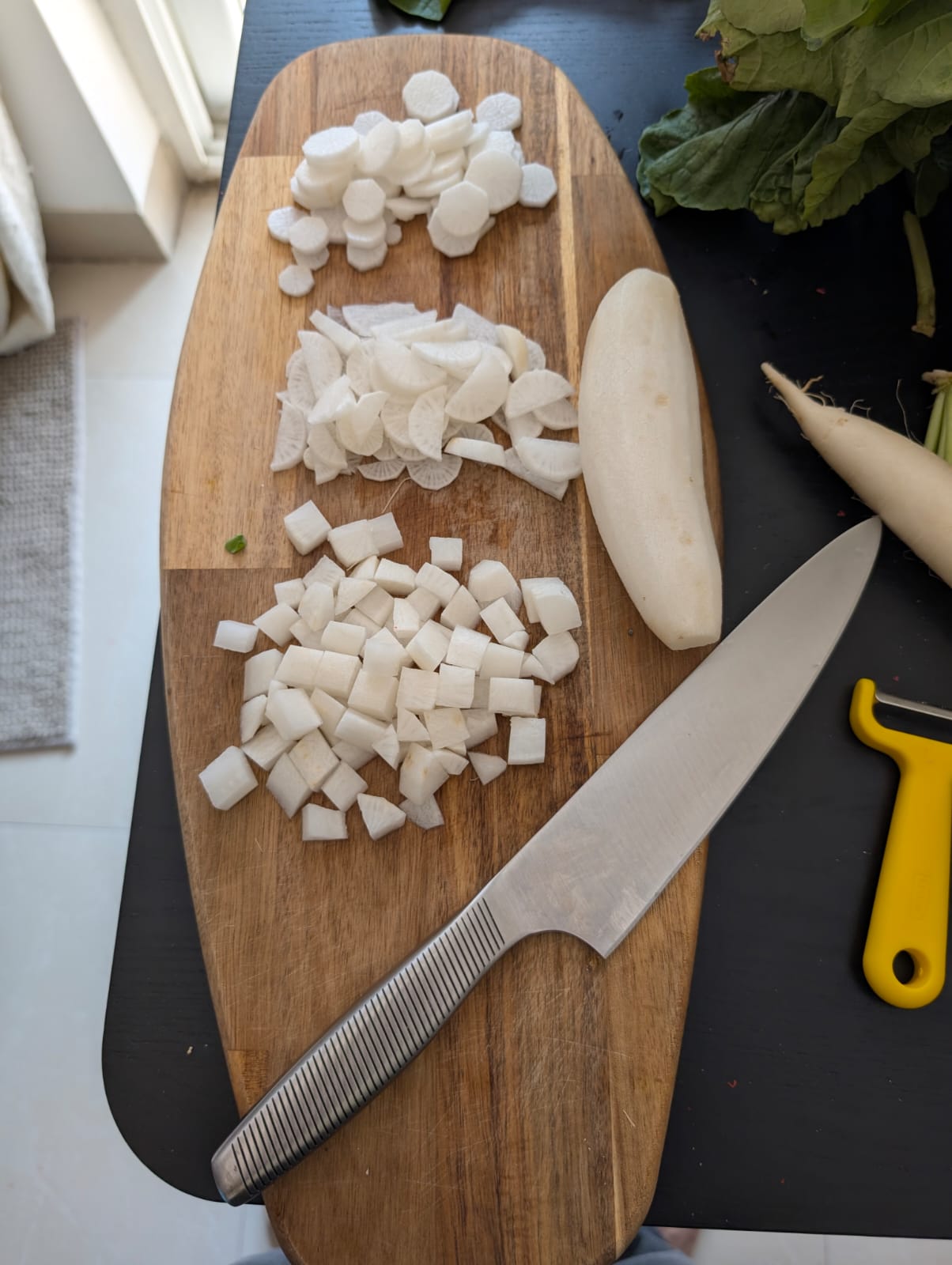 I had hired help to chop vegetables for my pickles.
They didn’t turn up.
So I became the vegetable chopper. Literally.
I chopped about 10–12 kg of vegetables. Not as a symbolic founder-story moment. As a practical, “this has to get done” reality. Alongside that, I was also doing the work that founders like to believe is their real job: measuring ingredients, making sure proportions were right, tasting, adjusting, deciding the final output.
What struck me was how quickly the “strategic” and the “manual” collapsed into one. There was no hierarchy of tasks. There was only the product that needed to exist by a certain time.
That was the first founder lesson of the day:
- When something breaks, the founder becomes the fallback.
- When a role is missing, the founder fills it.
- When time runs out, the founder doesn’t get to say “not my job.”
It wasn’t inspiring. It was grounding. There’s a difference.
The Product Work Is Hard… But It’s Finite
Making the product from scratch is real work. So is costing. So is measuring. So is calculating what you can sell at and still make sense. None of it is cute.
But it’s contained.
There’s a beginning, middle, and end. You can complete it. You can pack it. You can label it. You can say, “Okay, this is done.”
Then came the part that isn’t finite. The part that doesn’t end neatly. The part that reveals you.
Selling.
Honest Selling Is a Different Kind of Mirror
At the stall, something shifted in me.
For once, I wasn’t trying to win the internet. I wasn’t worrying about Instagram algorithms, aesthetics, timing, captions, or whether my “brand voice” sounded like a brand voice. There was no scope for performative confidence. No room to hide behind a screen and call it marketing.
It was just:
- my product,
- in front of people,
- in real time.
They tasted it. They liked it or they didn’t. And I could see it instantly.
Some people came back for seconds of my kanji.
That did something to my nervous system.
I’ve always assumed I would be emotionally attached to what I make in a fragile way—like if someone didn’t buy, or didn’t like it, I’d feel personally rejected. But I didn’t. I expected to feel wounded. I felt clear.
It was product validation in its most honest form. And “honest” is the keyword here.
Online, rejection is vague. You don’t know if the product is wrong, the audience is wrong, the timing is wrong, or the algorithm simply didn’t care. Offline, at a stall, you get clean feedback. It stings less because it’s truthful. There’s no mystery to spiral about.
Standing behind a stall taught me something I wasn’t expecting:
Selling can feel like integrity when you’re fully present.
You’re not manipulating. You’re not begging. You’re not trying to sound like everyone else. You’re just offering something and letting reality respond.
Finding the Right Words Without Becoming Loud
I leaned on what I’ve learned from many years in HR and being part of multiple events. Not in a “corporate skills saved me” way, but in a very practical way: I knew how to speak to people without sounding like I was either performing or pleading.
I was clear with myself going in: this isn’t a guaranteed win. But what I might gain is worth more than what I might lose.
What I gained wasn’t just sales. It was confidence. Not the motivational kind—the earned kind.
Also, Soul Sante gave me something I didn’t expect: a space where I could pitch without my body going into panic. I could speak about what I do without apologizing for taking up space.
That’s not a small thing.
Building a Business Takes a Village (And That’s Not a Weakness)
Somewhere in the middle of the day, I had this thought: we always say raising a child takes a village. I think building a business does too.
Not in a sentimental way. In an operational way.
My in-laws showed up in ways that made me feel held, not “helped.” There’s a difference. Help feels like a favour. Held feels like belonging.
Here’s what that village looked like:
- My father-in-law, a veteran marketing professional, complimented my sales pitch. That one sentence landed heavily. Not because I needed permission—but because it was validation from someone who actually knows what good marketing sounds like.
- My mother-in-law coloured posters. And she didn’t just “do a task.” She checked on me like I was a human being: Have you eaten? Are you hydrated? Don’t skip food.
- My sister-in-law spent her day off doing craft work—cutting little hearts to make the stall look warm and inviting. She gave inputs, stood by, and manned the stall when we needed a break. Quiet support is its own kind of leadership.
- My husband, my biggest support, practically took over the outreach energy. He stood outside the stall and invited people to try. He generated a crazy number of leads. I did the deeper conversations because I know the product inside out, but he opened the door for those conversations to even happen.
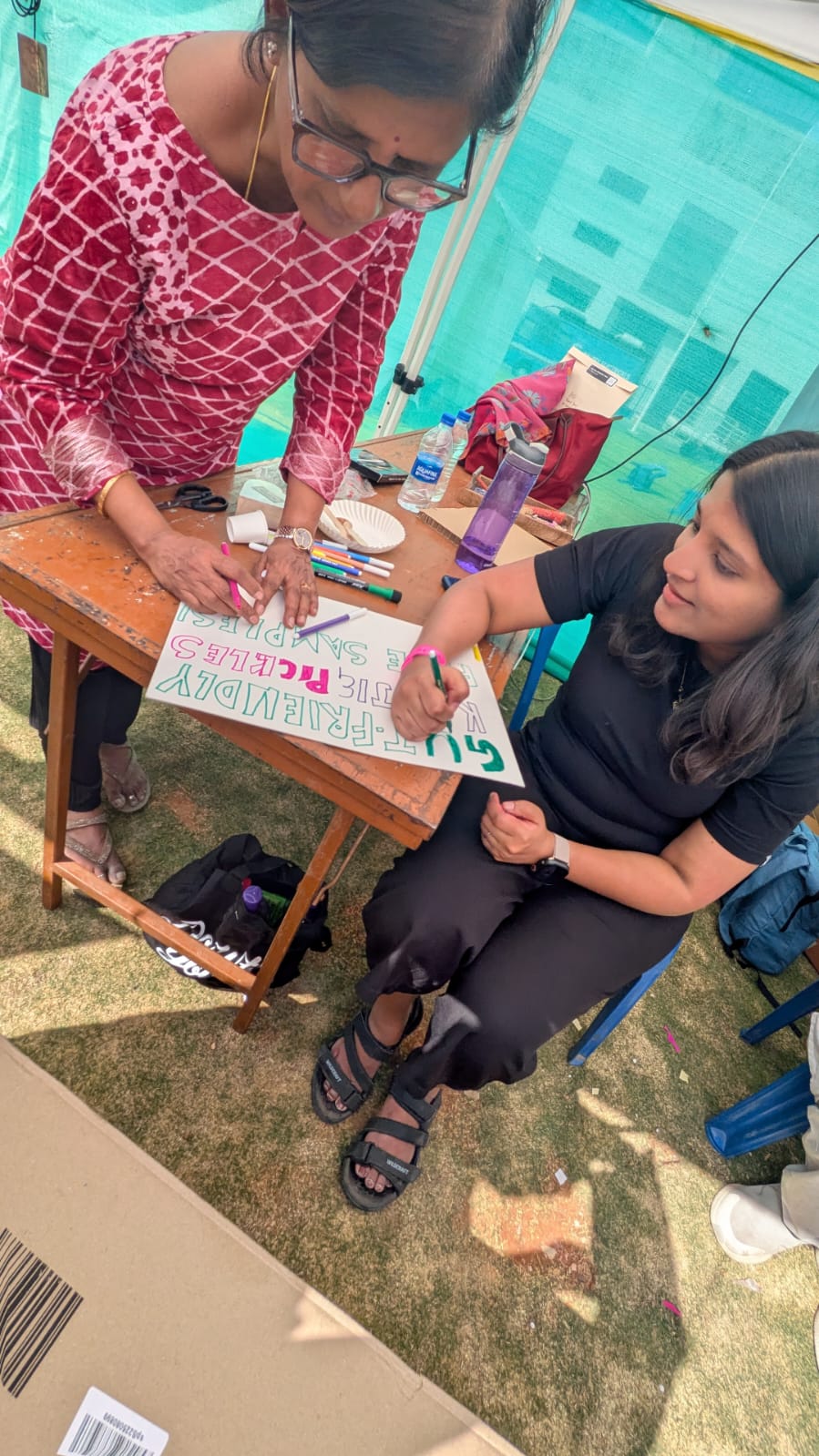
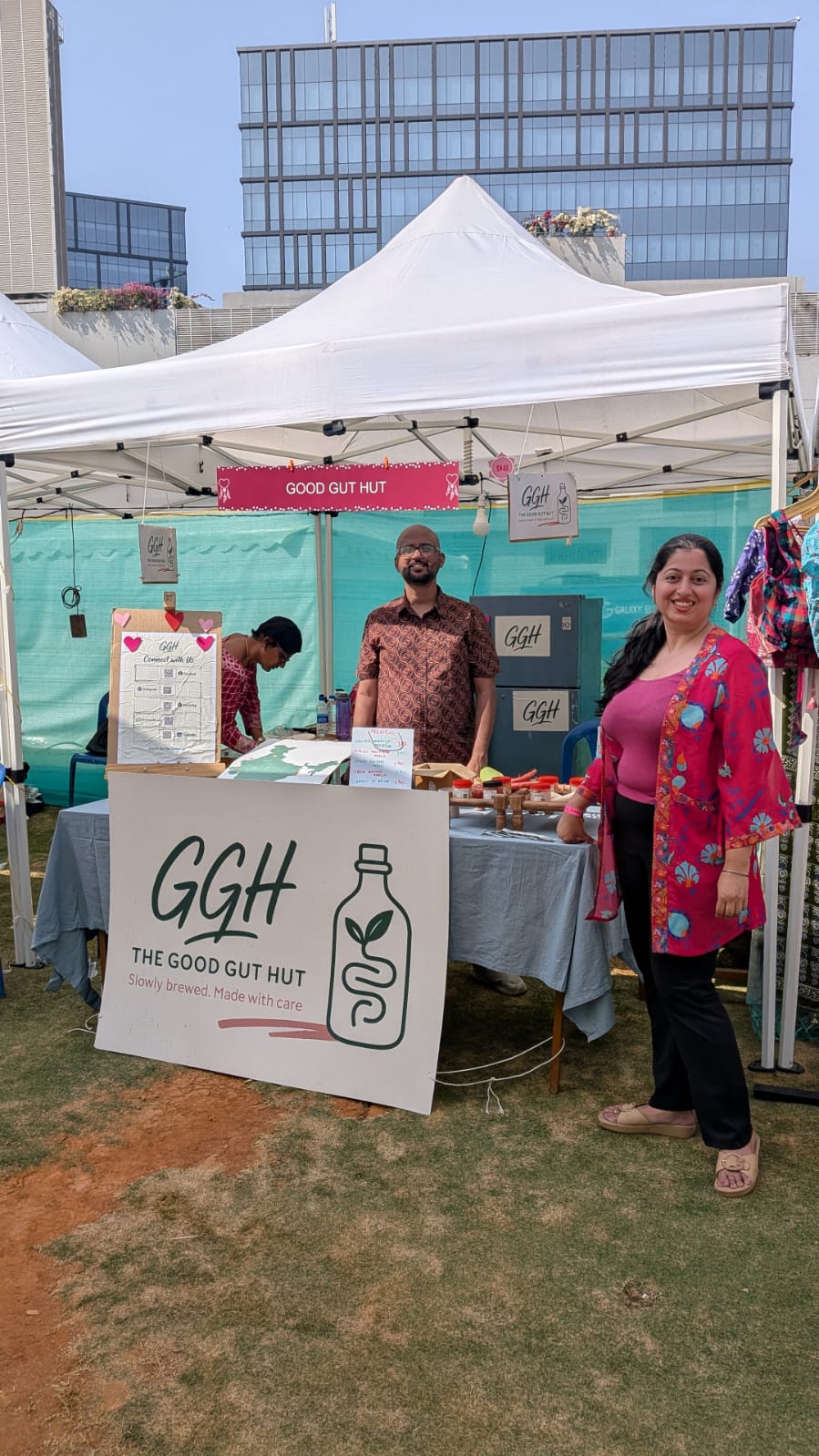
(FIL was behind the camera - usually something I remember to do but was too preoccupied)
At one point, they even stuck around for a couple of hours so the stall would look crowded. That detail matters, because it shows you how business is never just business. Perception matters. Energy matters. Sometimes, bodies in the room matter.
We borrowed their car to travel. Their driver helped us load. When people talk about founders “doing it all,” I want to ask: with whose invisible labour behind them?
It was a 14–15 hour day.
I could not have done it alone.
And I don’t say that as a confession. I say it as a correction.
The Founder Myth vs. Founder Reality
We love the founder narrative where someone has a vision, builds in isolation, and emerges triumphant.
But building something small and real is nothing like that.
It asks for humility before it asks for confidence. It asks for stamina before it asks for strategy. It asks you to be okay doing the “small” tasks because there is no small task when you’re responsible for the whole.
And it asks you to be connected.
Connectedness isn’t just emotional. It’s not just “gratitude.” It’s strategic in the most practical sense: businesses don’t move because one person is brilliant. They move because multiple people make it possible for the work to exist.
That day made a few truths uncomfortably clear:
- The product is only one piece of the business.
- Visibility is a skill, not a personality trait.
- Selling in person is a fast-track to reality.
- Support systems aren’t a luxury; they’re infrastructure.
- Humility isn’t a virtue-signaling word—it’s operational.
If I had walked in thinking this was just an event where I’d “test the market,” I would’ve missed the bigger education happening under the surface.
Soul Sante gave me product validation, yes—but more than that, it showed me what founding actually looks like when the noise drops. It looks like chopping vegetables when your plan fails. It looks like owning your work without hiding behind algorithms. And it looks like being carried by a village you’re willing to lean on. Humility and connectedness aren’t soft lessons; they’re the real foundations.