
The AI Draft → Publish Pipeline: From Raw Output to Real Authority
AI can generate drafts in seconds—but authority requires judgment. This tactical pipeline shows how to move from raw AI output to structured, edited, optimized, and ethically published work without lowering your standards.
Posted by

Related reading
When Voice Cloning Becomes Accent Caricature
AI voice cloning can preserve a speaker’s timbre while replacing their pronunciation and cadence with a demographic stereotype. Treating Indian English as a single preset turns personalization into systematic misrepresentation.
Cameras and microphones capture well-defined physical signals, while smell and taste emerge from complex chemical patterns. Electronic noses and tongues exist, but their sensors and AI remain specialized rather than universal.
AI Product Demos Need UI Understanding, Not Just Editing
Most “AI demo” tools are just smarter screen recorders working on pixels. The real leap is treating the interface like a scene—auto-directing zooms, pacing, and highlights based on what the UI elements mean.
The AI Draft → Publish Pipeline
AI can accelerate writing. It cannot replace judgment, positioning, or accountability. The difference between spam and leverage is the pipeline.
This is a tactical, repeatable system for turning raw ideas into durable, high-quality, ethical publications—without pretending an AI draft is “done” just because it’s long.
If you’re starting from messy transcripts or brainstorming sessions, begin with:
How to Convert ChatGPT Conversations Into Blog Posts.
What follows assumes you already have a draft.
1) Generate (produce raw material fast)

Objective: Get to something editable as quickly as possible.
Generation is about momentum, not precision. Treat the first output like clay: useful because it exists, not because it’s shaped.
Provide up front:
- Working thesis (one sentence)
- Audience definition (who it’s for, what they already know)
- Intended outcome (inform, persuade, clarify)
- Constraints (length, tone, must-include, must-avoid)
How to run it:
- Prompt for a full draft—not “ideas.”
- Encourage overproduction.
- Do not edit while generating.
Good looks like:
- You have options.
- There are multiple angles.
- It’s repetitive and uneven. That’s fine.
2) Extract (separate signal from AI noise)
Objective: Decide what survives before you polish anything.
AI drafts fail predictably:
- Repetition with new wording
- Consulting tone and inflated transitions
- Safe abstractions
- Confident claims with no grounding
If you’ve read Why AI Drafts Sound Generic (And How to Make Them Sound Like You), you already know what to look for.
Extraction process:
- Highlight strong insights.
- Delete redundancy aggressively.
- Flag vague claims.
- Isolate distinctive framings.
Ask:
- What is actually original?
- What would I stake my name on?
- What would I delete without regret?
Output: A shorter document with sharper intent.
3) Structure (build architecture before prose)
Objective: Make the piece logically inevitable.
Structure determines clarity more than wording. A reader should skim your headings and understand:
- what you’re arguing,
- what they’ll get,
- where to jump.
Useful frameworks:
- Problem → Solution → Method → Risks
- Principle → Application → Example
- Before → After → Bridge
- Stage-based pipeline
Checks that prevent mush:
- Each section has one job.
- No overlapping sections.
- Sequence is causal or procedural.
- One clear promise.
If this step feels unclear, revisit your thesis before touching sentences.
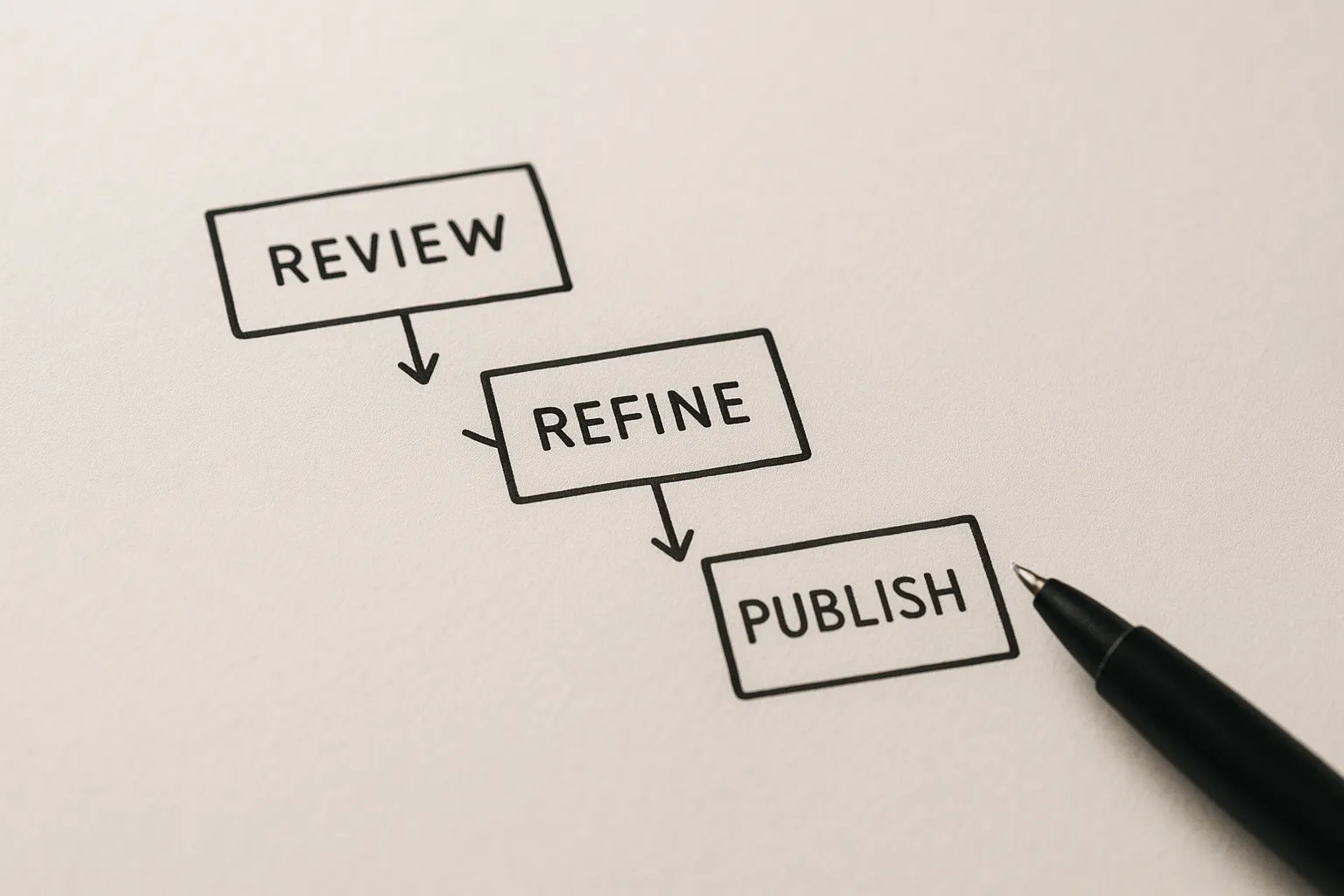

Output: An outline that stands on its own.
4) Edit (turn structure into owned writing)
Objective: Convert architecture into accountable prose.
Editing is where AI content either becomes real work—or collapses.
If you want the full breakdown of editing layers, see:
How to Edit ChatGPT Output So It Doesn’t Sound Robotic (7 Practical Fixes).
Here’s the compressed version:
Layer 1: Precision
- Cut filler.
- Replace vague verbs.
- Remove redundancy.
Layer 2: Authority
- Remove unnecessary hedging.
- Support important claims.
- Delete what you can’t defend.
Layer 3: Specificity
- Add examples.
- Add constraints.
- Add decision rules.
If your draft still sounds clean-but-hollow, you likely need to insert perspective.
See:
How to Add Original Thinking to an AI Draft (So It Doesn’t Sound Like Everyone Else).
Layer 4: Voice calibration
Match tone to intent:
- Tactical → short, directive.
- Analytical → defined and bounded.
- Narrative → selective detail.
AI can propose alternatives. You own the final call.
5) Optimize (make it discoverable and usable)
Objective: Align good writing with real search intent and usability.
Optimization is not keyword stuffing. It’s alignment.
For the tactical SEO checklist, see:
How to Optimize AI-Generated Blog Posts for SEO (Without Sounding Like Spam).
High-level reminders:
Title
- Clear benefit.
- Format implied.
- No vague metaphors.
SEO basics
- Identify intent.
- Use key phrases naturally.
- Avoid forced insertion.
Readability
- Short paragraphs.
- Clear headings.
- Bullet precision where needed.
Internal links
Connect:
- Prerequisites.
- Deep dives.
- Related methods.
Clusters compound authority.
6) Publish ethically (protect trust)
Objective: Use AI without eroding credibility.
If you haven’t already, read:
Publishing ChatGPT Threads Without Crossing Ethical Lines.
Core rules:
- Don’t imply authorship you didn’t exercise.
- Don’t paraphrase competitors and call it original.
- Verify claims.
- Own every sentence.
And if your fear is “Will Google penalize this?”, the real issue isn’t AI—it’s low-value pages.
See:
Does Google Penalize AI-Generated Blog Posts? What Actually Matters in 2026.
Ethics isn’t decoration. It’s risk management.
7) Update (turn posts into assets)
Objective: Make publishing versioned, not disposable.
Review performance
- Traffic (with intent)
- Engagement
- Conversions
- Qualitative feedback
If readers drop off, it’s usually structure—not marketing.
Refresh cycles
Every 3–6 months:
- Tighten bloated sections.
- Update examples.
- Clarify definitions.
- Add new insights.
Expand or consolidate
- Spin out high-performing sections.
- Merge overlapping posts.
- Reduce internal competition.
Versioning beats volume.
Conclusion
This pipeline works because it separates speed from judgment.
AI handles generation.
Humans handle taste, ethics, and consequence.
Run the steps in order and the output stops looking like “AI content.” It starts looking like deliberate publishing.
The compounding advantage isn’t writing faster.
It’s shipping consistently without lowering the bar.