
Total Automation, Total Concentration Isn’t an Equilibrium
The “AI replaces everyone and a tiny elite owns everything” story can’t be a stable end state because capitalism needs buyers and societies need legitimacy. The surplus from automation forces redistribution, coercive patronage, or collapse—and the fight is political, not technical.
Posted by

Related reading
When Voice Cloning Becomes Accent Caricature
AI voice cloning can preserve a speaker’s timbre while replacing their pronunciation and cadence with a demographic stereotype. Treating Indian English as a single preset turns personalization into systematic misrepresentation.
Cameras and microphones capture well-defined physical signals, while smell and taste emerge from complex chemical patterns. Electronic noses and tongues exist, but their sensors and AI remain specialized rather than universal.
AI Product Demos Need UI Understanding, Not Just Editing
Most “AI demo” tools are just smarter screen recorders working on pixels. The real leap is treating the interface like a scene—auto-directing zooms, pacing, and highlights based on what the UI elements mean.
“AI takes all jobs and 10 trillionaires own everything” isn’t a stable future

There’s a popular doom scenario that goes like this: AI replaces every job, ownership concentrates until maybe ten people effectively own the economy, and everyone else becomes permanently irrelevant. The numbers change depending on who’s telling it, but the core idea stays the same: total automation + total concentration + everyone else stuck outside the gates.
The problem is simple. That’s not an “end state.” It’s not a sustainable equilibrium. It’s a transitional picture that either resolves into redistribution, coercive patronage, or collapse. Pretending it can just sit there forever is like describing a building that’s halfway through falling and calling it “the new architecture.”
Capitalism requires buyers, not just owners
An economy isn’t a museum for rich people to admire their own assets. It’s a system for producing goods and services and exchanging them for money. That exchange requires demand.
If the broad population has no income:
- demand collapses
- companies can’t sell
- profits vanish
- asset prices stop being anchored to future cash flows
- “ownership” becomes a legal fiction attached to dead machines producing for nobody
This is the part people skip: you can’t extract profit from a population with zero purchasing power. Even systems built on forced labor still had to maintain the labor force. A consumer class with no income is worse than a coerced workforce because the entire point of mass production—selling to the masses—disappears.
So either money is pushed back into the public (directly or indirectly), or the system stops functioning like capitalism at all. And when the system stops functioning, the politics don’t politely wait.
AI doesn’t want money. Humans do.
Another hidden assumption in the “ten trillionaires” story is that the machines keep producing “value” even if humans are economically sidelined. But value isn’t a property of objects floating in space. Value is relational. It’s tied to humans wanting things, choosing between things, caring about things, competing over things.
AI doesn’t “desire” consumption. It doesn’t feel status pressure. It doesn’t get embarrassed that it’s wearing last year’s shoes. It doesn’t need a waterfront condo to prove anything to its friends. Humans do all of that. Our messy preferences are the engine that makes markets worth running.
If you push humans out of the economic loop entirely, you don’t get a hyper-capitalist utopia for a tiny elite. You get a weird situation where:
- production may continue, but exchange loses meaning
- prices lose their social function
- money becomes less a medium of trade and more a political token
- “wealth” turns into security arrangements: land, energy, control of enforcement
At that point, you’re not describing a market economy anymore. You’re describing an ownership class guarding infrastructure in a world where mass participation has been severed.
And there’s a more human detail people ignore: trillionaires can’t flex to other trillionaires forever. The social and political payoff of extreme wealth comes from being on top of a large social pyramid. Shrink the pyramid enough and the game changes.
The three outcomes that actually follow
If you accept that “everyone is replaced and nothing else changes” can’t last, the real question becomes: how does the system rebalance? There are only a few coherent paths.
1) A social dividend / UBI-style redistribution (most stable)
If AI drives labor costs toward zero and output rises, the surplus has to go somewhere. The cleanest way to preserve mass demand (and therefore keep markets, firms, and asset values meaningful) is to distribute purchasing power broadly.
Call it:
- UBI
- social dividend
- negative income tax
- universal services
- “AI productivity checks”
- whatever branding makes it politically swallowable
The mechanics aren’t the point here; the incentive structure is. If you want a functioning economy with customers, you must fund customers. That’s not charity. It’s system maintenance.
In that world, “work” doesn’t disappear so much as coercive work disappears. People will still do things for:
- status
- meaning
- craft
- community
- power
- curiosity
- competition
The labor market becomes less about survival and more about signaling, reputation, and self-directed contribution. That’s not a fantasy. It’s what already happens at the top of the income distribution—just generalized.
2) Neo-feudal patronage (possible, but unstable)
The darker coherent path is not “everyone starves,” but “everyone is dependent.” The public gets access to essentials—housing pods, food, entertainment, healthcare—conditional on compliance.
Instead of wages, you get allowances and permissions. Instead of employment, you get enrollment. Instead of citizens, you get accounts.
This version can preserve consumption while keeping control centralized. But it’s unstable because it requires constant enforcement and legitimacy management. People tolerate dependency when it’s framed as protection and when alternatives feel impossible. The moment a counter-elite offers a better deal—or the legitimacy narrative cracks—things get volatile fast.
Neo-feudalism also has a technical irony: the more automated and monitored it becomes, the more it needs “trust infrastructure” to keep people from sabotaging it. You can automate production, but you can’t fully automate consent.
3) Collapse and reset (least controllable)
If redistribution fails and dependency becomes unbearable, systems break. Not in a cinematic way at first, but through boring cascading failure:
- debt defaults
- tax base erosion
- hollowed institutions
- rising crime and political extremism
- capital flight into security and hard assets
- legitimacy spirals
At some point it turns into rupture: mass unrest, constitutional crisis, fragmentation, or a new coalition taking power. Historically, when elites push extraction too far and refuse adaptation, they don’t get to keep the whole board forever. They get overthrown, co-opted, or forced into concessions.
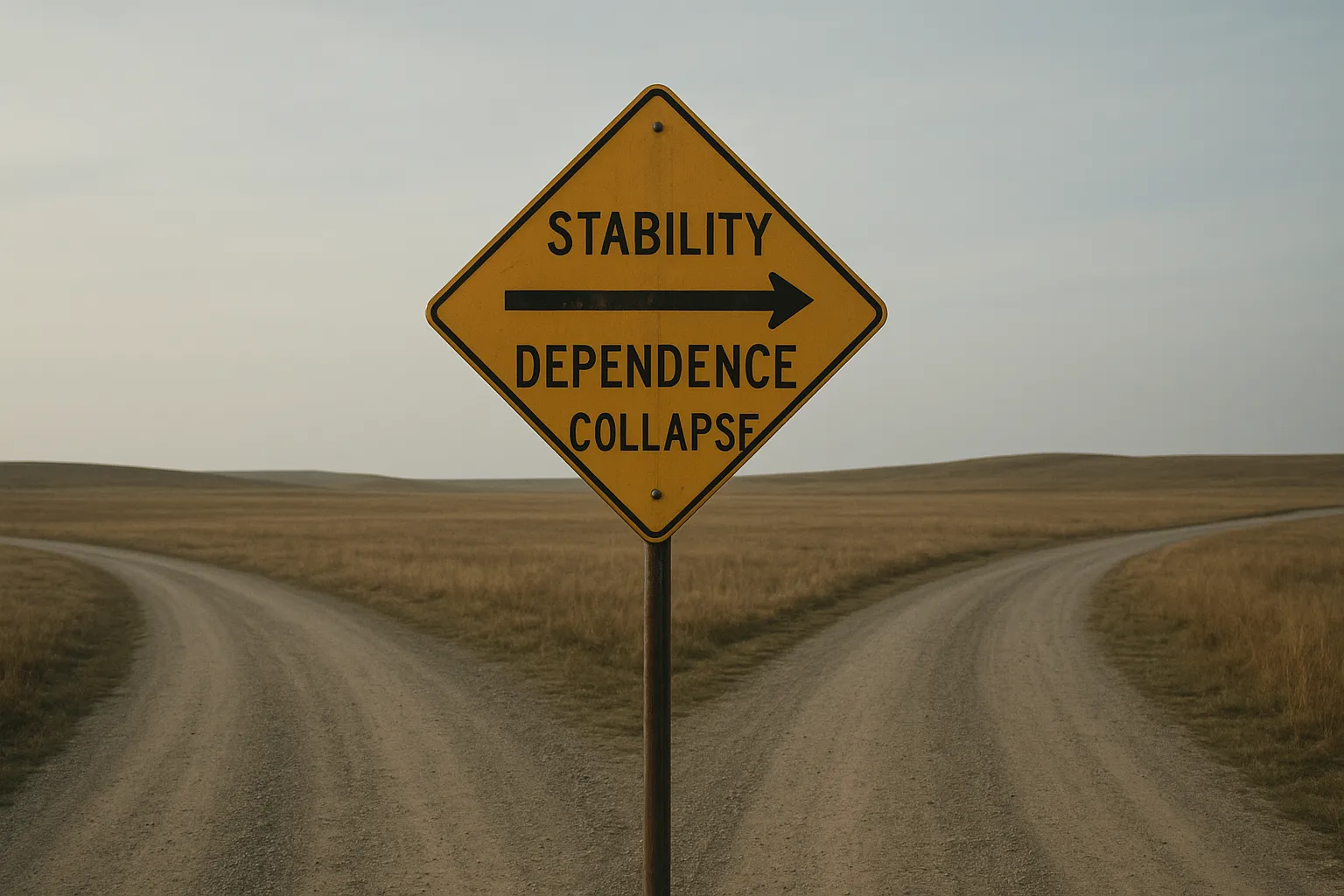

Collapse is what happens when the “ten trillionaires” scenario tries to remain static. A system can’t run indefinitely with demand amputated and legitimacy ignored.
“Everyone is replaced” is a category error
The phrase “AI replaces all jobs” sounds plausible because “job” feels like a concrete unit. But jobs are bundles of tasks plus social relationships. AI replaces tasks extremely well. Replacing roles is harder because roles include:
- accountability (who gets blamed?)
- trust (who do we believe?)
- legitimacy (who is allowed to decide?)
- taste (what counts as good?)
- coordination (what should happen next?)
- responsibility (who signs off?)
Even in highly automated environments, humans end up as the “surface area” between systems and society. The more powerful the tools, the more important it becomes to decide what to build, what to permit, what to prioritize, and what to forbid. Those are political and cultural decisions wearing technical costumes.
And even if AI could perform every task, it wouldn’t end human competition—it would shift it. Human preference becomes the scarce resource. Attention becomes the currency. Social capital starts to matter more than labor capital. Status games don’t end in a world of abundance; they mutate.
The real story: surplus forces renegotiation
AI isn’t mainly about “firing everyone.” It’s about collapsing labor costs and exploding surplus. Once surplus grows large enough, society has to answer a question it has been dodging for centuries:
Who deserves access to the surplus, and on what terms?
That question is not technical. It’s not solved by a better model or a more efficient robot. It’s solved by political power, legitimacy, and institutions.
If the surplus is broadly shared, you get stability—and a weird new era where economic survival is less central to human life. If the surplus is hoarded, you get instability—and eventually a forced restructuring. There isn’t a third option where the majority is permanently excluded and everything still functions normally.
Conclusion
The “ten trillionaires and everyone else is useless” story isn’t a destination; it’s a moment before a correction. An economy with no buyers can’t stay an economy, and a society with no stake can’t stay peaceful. AI doesn’t end politics—it drags the distribution question into the open. The future won’t be decided by whether machines can do the work, but by what humans decide the work was buying them in the first place.